Men's Chest Harness Sizing Guide
Where to place the tape, how to read the adjustment range, and what to do when a chest harness rides up, digs in, or sits wrong.

Table of Contents
To size a men's chest harness, measure around the fullest part of your chest, under the armpits and across the pecs, with a soft tape held level. Compare that number with the adjustment range of the harness, and aim for the middle of the range so you can tighten or loosen it later.
How do you measure for a chest harness?
You need a soft tape, a mirror, and about five minutes. A metal builder's tape will not bend around your chest, so do not use one. If a partner can help, even better, since reading a tape on your own back is how most wrong numbers happen.
- Stand straight with your arms relaxed at your sides. Wear nothing thicker than a thin tee, because a hoodie adds a size to the reading.
- Wrap the tape around the fullest part of your chest, passing under the armpits and over the pecs and shoulder blades. Keep it level at the front and the back, since a tape that dips behind your shoulder gives a number that is too large.
- Breathe out normally and read the number. Do not flex or puff out your chest, because you will wear the harness at rest.
- Measure a second time. If the two readings differ, write down the larger one.
- If the style includes a waist belt, also measure around your natural waist at its narrowest point above the navel.
Write every number in both inches and centimeters, since listings and tape measures do not always use the same unit. No soft tape at home? Lay a piece of string around your chest, mark where it overlaps, and measure the string against a ruler.
When does torso length matter?
Chest circumference is only half of the story for styles with shoulder straps that connect to a waist belt. Those designs depend on the distance from your shoulder to your waist. Measure from the top of your shoulder, next to the neck, straight down the front of the torso to the point where a belt would sit.
Two men with the same chest can need very different strap lengths. If the torso length is longer than the straps can reach, the harness pulls upward and presses on the collarbone. If it is shorter than the strap needs, the chest section hangs low and shifts every time you move. A long torso with a narrow chest is a combination that can go wrong, so if that sounds like you, give the torso number as much attention as the chest number.
For a harness that ties chest and waist together, the torso measurement decides whether the straps sit where they should. The wide-strap model with a waist belt is the clearest example, and it works best when you have checked both lengths before you order.
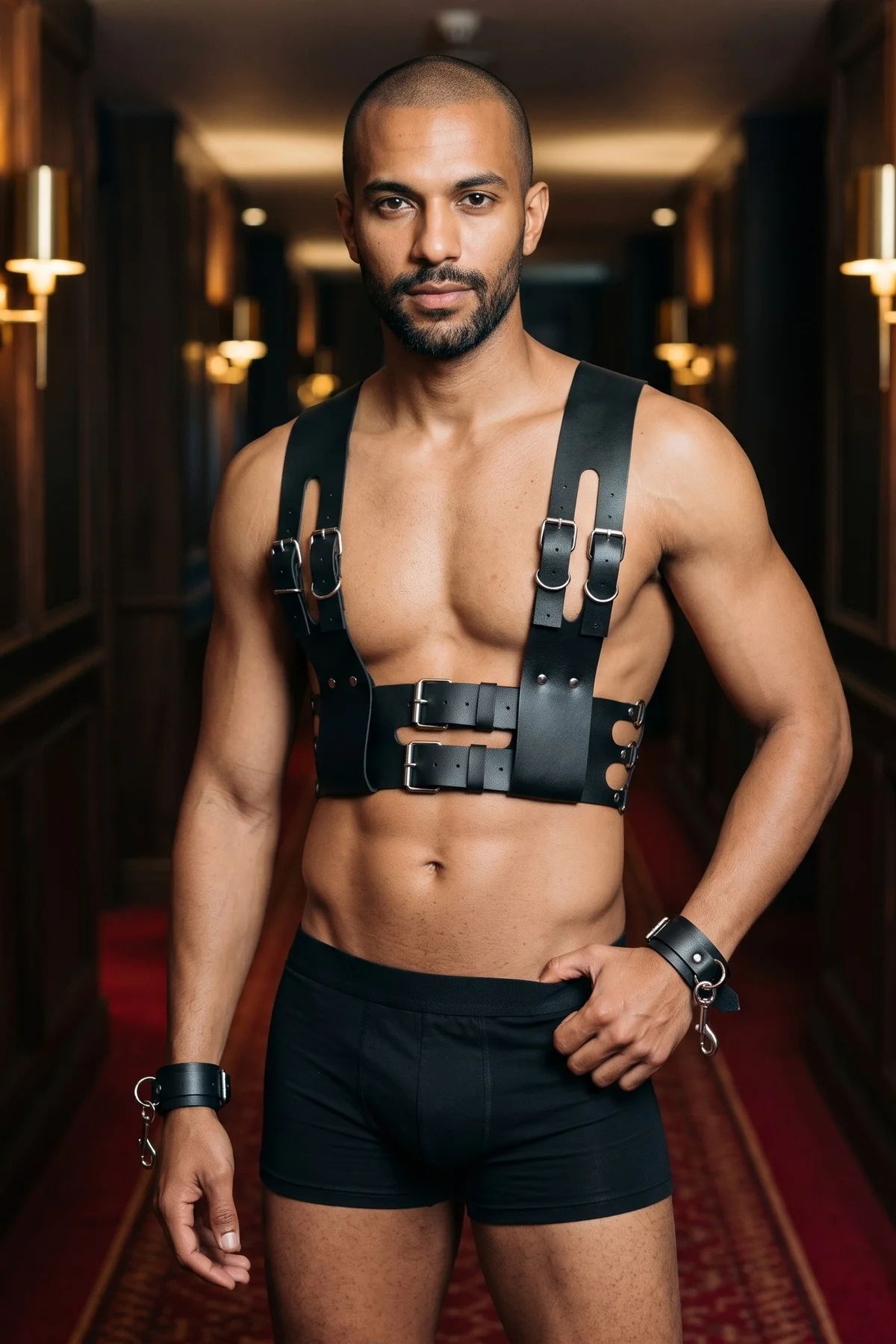 Buckled Chest Harness with Wide Shoulder Straps and Waist Belt
$79.66
Read More →
How do you read the adjustment range?
Most harnesses in the chest harness range use adjustable buckles or straps, so the label size is less important than the minimum and maximum circumference the straps can reach. Your measurement should land in the middle third of that range. That leaves room to tighten when you move around and to loosen when you warm up.
Do not forget the overlap. A strap needs a few inches of tail past the buckle to hold securely, and a harness set at the extreme end of its range has almost none. If you have to pull every strap to its last hole just to make the harness stay on, it is too big, and if the tongue barely reaches the first hole, it is too small.
| Style | What to measure | If it is too small | If it is too big |
|---|---|---|---|
| Crisscross or framing chest harness | Chest circumference | Straps dig into the pecs and under the arms | Straps slide and the center shifts to one side |
| One-shoulder harness | Chest and the diagonal from shoulder to the opposite ribs | The diagonal strap pulls up toward the neck | The strap droops off the shoulder |
| Wide straps with a waist belt | Chest, torso length, and waist | The harness pulls upward and presses on the collarbone | The chest section hangs low and the belt rides up |
Which styles are more forgiving if you are between sizes?
A single-shoulder design is usually the easiest to fit, because one strap carries most of the load and the rest of the harness is lightly tensioned. If you are between sizes or your build changes with training, that gives you more room for error than a full crisscross layout.
A black single-shoulder style is a sensible place to start if this is your first harness and you want to learn how the straps feel on your body.
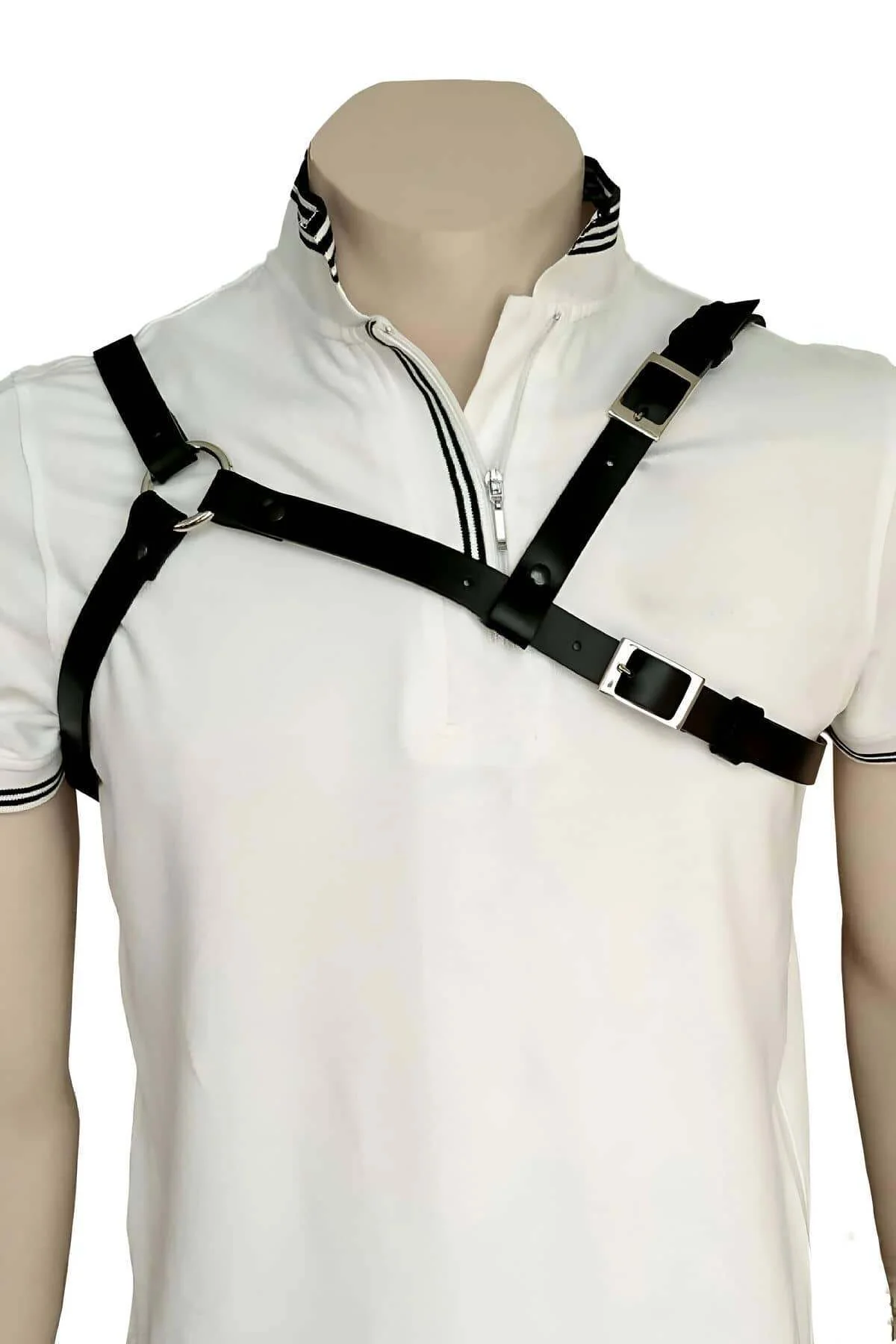 Black Faux Leather Single-Shoulder Chest Harness
$30.66
Read More →
For a harness that goes under an open jacket and has to stay put, an adjustable one with several buckle points lets you set the chest and shoulder drop separately. The red adjustable model below is a good example of the style, and it is also the one where you will notice a wrong shoulder length fastest.
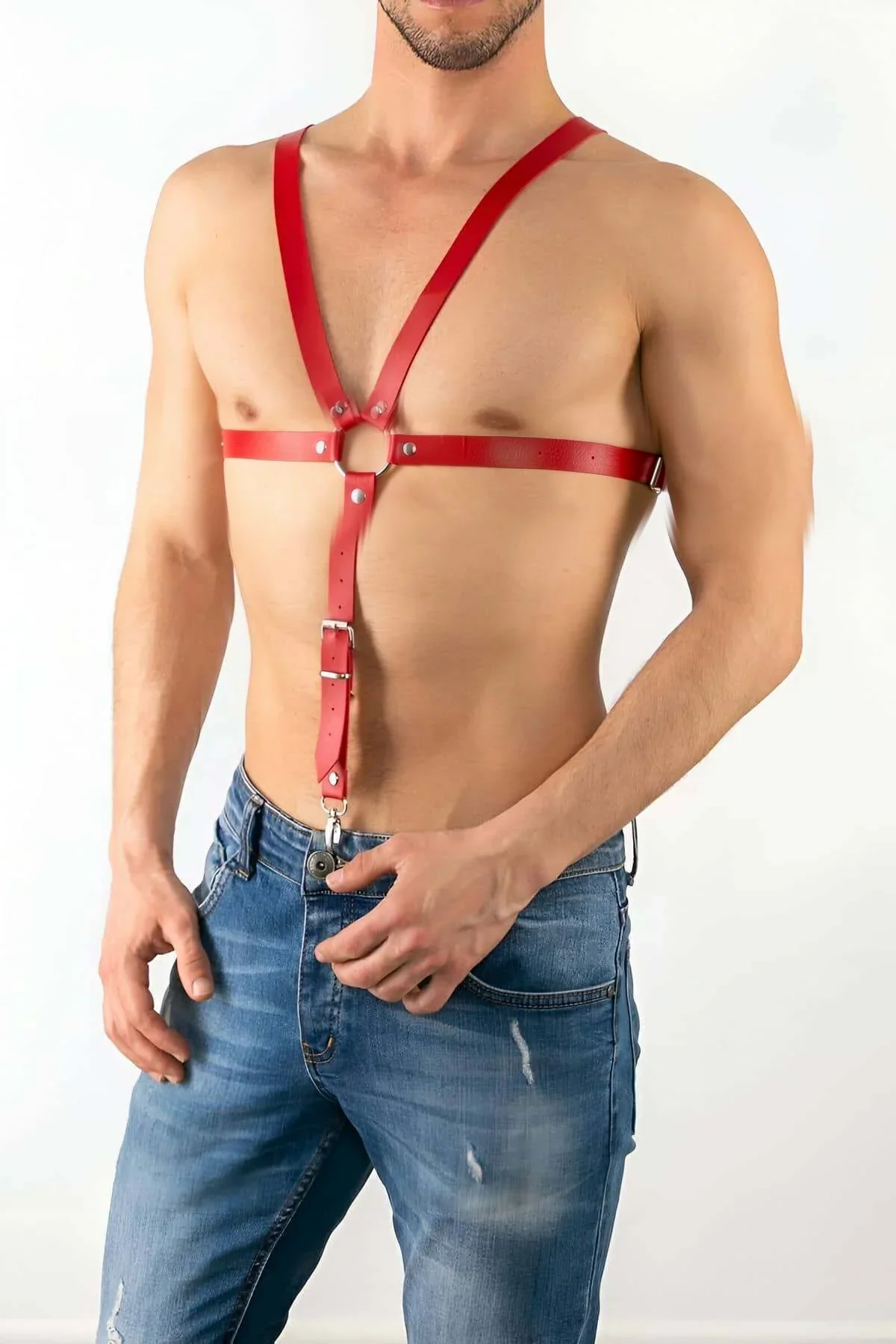 Mens Leather Chest Harness - Adjustable Red Body Accessory
$26.46
Read More →
What sizing mistakes should you avoid?
- Measuring over a jacket or a thick sweater, which adds a full size to the number.
- Pulling the tape tight enough to compress the chest, which gives a number smaller than the harness needs at rest.
- Choosing by shoulder width alone, since the chest circumference and torso length decide how the harness sits.
- Assuming snug means secure. Over-tight straps leave marks and limit your breathing, while a well-set harness is held in place by correct length and a good anchor point.
- Counting on the material to stretch. Faux leather will not loosen over time the way hide does.
Build changes the picture too. Broad pecs or heavy lat development raise the chest number faster than the torso length, so lifters should measure after training when the chest is at its fullest, not first thing in the morning.
How do you test the fit at home?
Put the harness on over a thin base layer and close it at the middle setting. Raise both arms over your head, lower them, and twist at the waist. The harness should stay in place, with straps resting flat against the body rather than cutting in at an angle. Take a deep breath and check that nothing pulls tight across the ribs.
If a strap leaves a deep line after ten minutes, loosen it one hole. If the harness shifts when you raise your arms, tighten the lowest anchor first, whether that is the back buckle or the waist belt, before touching the shoulder straps. Anchoring the base first fixes most slipping problems without squeezing the chest.
Keep the harness on for at least half an hour at home before you wear it out. Strap points that feel fine for two minutes often start to rub around minute twenty, and it is much easier to adjust at home than at a crowded event.
❓ Frequently Asked Questions
+ Where do you measure for a chest harness?
Measure around the fullest part of your chest, with the tape passing under your armpits and across your pecs and shoulder blades. Keep it level all the way around and read it while you breathe out normally. Do not flex or puff up, because a harness is worn at rest.
+ Should a chest harness be tight or loose?
It should feel snug but never restrictive. You should be able to slide two fingers under any strap, take a full breath, and raise your arms without the harness riding up. If you see deep marks after an hour, loosen it a notch.
+ What if I am between two sizes?
Pick the size where your measurement sits in the middle of the adjustment range. If you are right on the edge, the larger one is the safer bet, because you can tighten the buckles but a harness that is too small cannot be made bigger.
+ Does a faux leather harness stretch?
Very little. Faux leather (PU) does not soften and mold to the body the way hide does, so you cannot count on it to loosen up. That is why the buckle range matters more than the size label, and why trying it on at home before an event is worth the ten minutes.


